15% fall discount applied automatically at checkoutFree USA shipping over $100Free worldwide shipping over $200Credit/debit checkout disabled for updates
Sign in 0

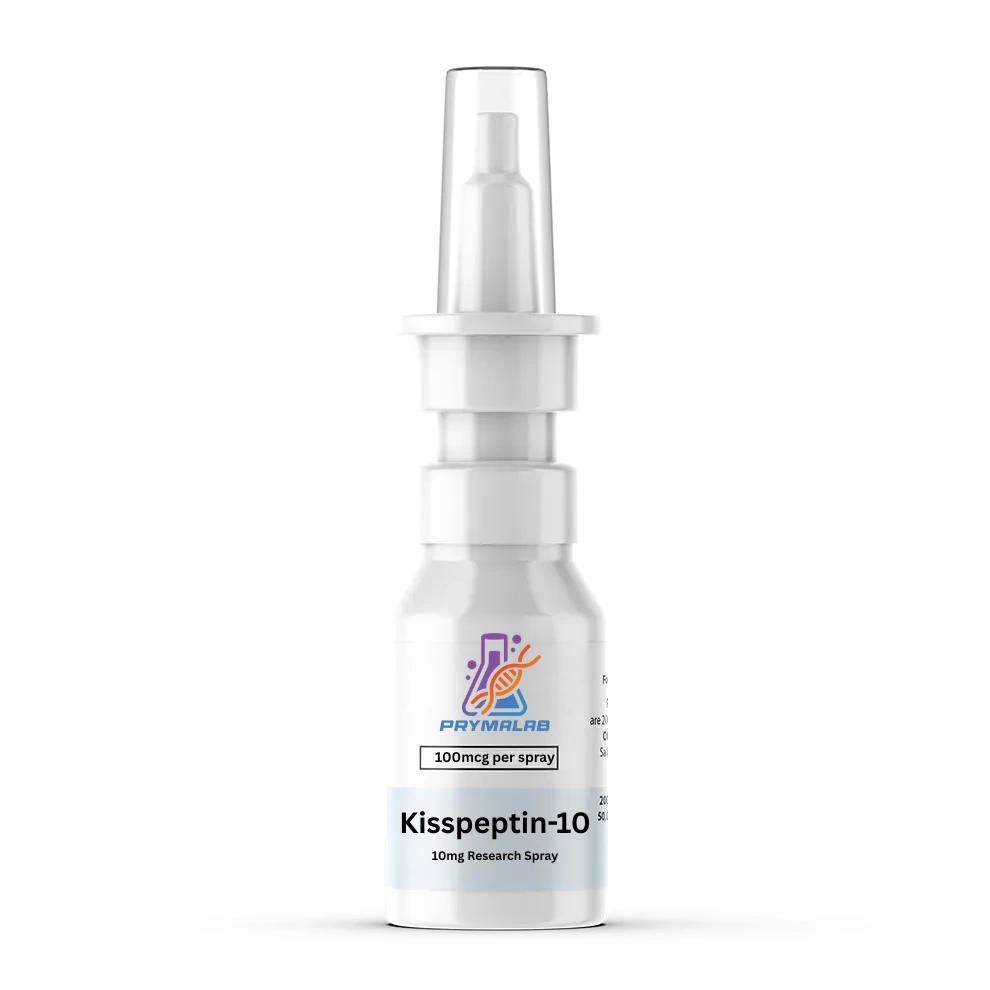
Kisspeptin-10 10mg Nasal Spray

(5 customer reviews)

$89.99 or subscribe for $75.99/mo

Kisspeptin-10 nasal spray supplies KP-10, the decapeptide YNWNSFGLRF-NH2 (CAS 374675-21-5, C63H83N17O14, 1302.4 Da), the C-terminal fragment shared by all active kisspeptins and the minimal sequence for full activity at KISS1R. C-terminal amidation is required for activity. Characterized by reversed-phase HPLC for purity and mass spectrometry for identity, with independent third-party testing. In-vitro laboratory research only. Not for human use.

Description

PrymaLab · Research Use Only

Kisspeptin-10 Nasal Spray

YNWNSFGLRF-NH2 · CAS 374675-21-5 · 1302.46 Da

Kisspeptin nasal spray supplies the decapeptide Tyr-Asn-Trp-Asn-Ser-Phe-Gly-Leu-Arg-Phe-NH2, CAS 374675-21-5, molecular weight 1302.46, as a metered aqueous solution. The molecule has two independent degradation routes that each add exactly one dalton, and neither is visible on a standard purity chromatogram.

Specification Table

Kisspeptin-10 verified chemical and format data
Property Value
Compound Kisspeptin-10, human
Alternative designation Kisspeptin-112-121, metastin 45-54
CAS number 374675-21-5
Molecular formula C63H83N17O14
Molecular weight 1302.46 g/mol
Residue count 10
Single-letter sequence YNWNSFGLRF-NH2
Three-letter sequence Tyr-Asn-Trp-Asn-Ser-Phe-Gly-Leu-Arg-Phe-NH2
Terminal modification C-terminal amide. Required for receptor binding
Peptide family RF-amide, named for the C-terminal Arg-Phe-NH2 motif
Parent protein Kisspeptin, the product of the KISS1 gene
Receptor KISS1R, also designated GPR54
Reported binding affinity Ki 2.33 nM at the human receptor and 1.59 nM at the rat receptor in published work
Deamidation-prone residues Asparagine at positions 2 and 4, plus the C-terminal amide itself
Oxidation-prone residues Tryptophan at position 3
Chromophore Tryptophan at position 3 and tyrosine at position 1. 280 nm absorbance applies
Format Metered nasal spray, solution state
Physical state Aqueous solution, supplied ready to use
Purity Per lot-specific certificate of analysis
Storage 2-8°C, protected from light. Do not freeze
Regulatory status No approved human or veterinary formulation in any jurisdiction

Why Are the Degradation Routes Invisible?

This compound has a specific analytical problem that most peptides do not, and it is the most useful thing to know before buying a solution-state preparation.

The C-terminal amide is not decoration. It defines the RF-amide family and it is required for receptor binding. Lose it and the molecule becomes a carboxylic acid with sharply reduced affinity.

Amide hydrolysis replaces an amine with a hydroxyl, which changes the molecular weight from 1302.46 to roughly 1303.45. The difference is one dalton.

Separately, the asparagine residues at positions 2 and 4 deamidate to aspartate. That reaction also adds one dalton, and it is one of the most common spontaneous modifications in peptide chemistry.

So the molecule has three sites that each produce a plus-one mass shift. A low-resolution mass spectrometer reporting a nominal mass cannot distinguish 1302 from 1303.

Chromatographic separation of these species is possible but not guaranteed under a routine gradient, since the structural change is small and the retention shift can be minimal.

The practical consequence for kisspeptin nasal spray is that a preparation can degrade substantially at the position that matters most for receptor binding while continuing to pass a standard certificate of analysis.

One further wrinkle makes this harder than it first appears. Asparagine deamidation does not simply produce aspartate. It proceeds through a cyclic succinimide intermediate that opens to give either aspartate or isoaspartate.

Isoaspartate shifts the backbone by one carbon, which alters the peptide geometry substantially while leaving the mass identical to the aspartate form. Mass spectrometry cannot separate them at all.

Detecting isoaspartate requires a dedicated methyltransferase assay, which almost nobody runs on a commercial peptide. It is a real limit on what any certificate can tell you about this compound.

What Verification Actually Catches It?

The answer is more specific than asking for a higher purity number, and it is worth putting to a supplier directly.

High-resolution mass spectrometry resolves a one dalton difference comfortably, and the monoisotopic mass rather than the average mass is the figure that carries the information.

A certificate quoting a nominal or average mass to the nearest dalton has not answered the question. The instrument and the resolution both need to be stated.

Asking whether the method separates the amidated from the free-acid form is the direct version of the question, and a supplier who has considered it will have an answer.

Because deamidation accelerates in aqueous solution, the date of measurement matters as much as the number. A certificate from the manufacturing date describes material that no longer exists in an opened bottle.

The tyrosine and tryptophan give a genuine chromophore at 280 nanometres, so total peptide concentration is straightforward to measure even when the amide status is not.

That contrast is worth holding onto. Concentration here is easy and identity is hard. That is the reverse of the situation for most compounds in this catalogue.

What Does the Kiss1r Gpr54 Ligand Relationship Involve?

The receptor pairing is unusually well characterised for a compound in this catalogue, which makes the published numbers worth stating precisely.

The receptor was originally identified as an orphan G protein-coupled receptor designated GPR54 before its endogenous ligand was found, and it is now also designated KISS1R.

Published binding work reports a Ki of 2.33 nanomolar at the human receptor and 1.59 nanomolar at the rat receptor, which places this among the higher-affinity ligands in this range.

The parent protein is the product of the KISS1 gene, originally studied in the context of metastasis suppression. That is why the older literature uses the name metastin.

This decapeptide is the C-terminal fragment of that parent, and the fragment retains full receptor activity because the RF-amide motif at the carboxy terminus is the recognition element.

That structural fact is what makes the amide integrity question so consequential. The binding element and the labile group are the same chemical feature.

Longer forms including kisspeptin-54 exist and are separate compounds with their own registrations, so a citation needs to specify which length was used.

How Does 1302 Daltons Affect the Nasal Route?

This is the largest compound in the current spray batch, and size works against it on the variable that most reliably predicts transnasal transport.

Nasal absorption falls steeply with molecular weight, with the practical transition around 1,000 daltons where paracellular passage between epithelial cells becomes inefficient.

At 1302.46 daltons this compound sits above that transition, larger than Melanotan II at 1,024, Ipamorelin at 711.85 and Glutathione at 307.32.

Being above the threshold does not mean nothing crosses. It means the fraction is smaller and the variance between applications is wider, which raises the number of replicates an experiment needs.

The arginine gives a positive charge at physiological pH, and cationic molecules tend to bind a negatively charged mucosal surface rather than pass through it.

Published intranasal pharmacokinetic data for this compound is not established. The human clinical literature that does exist has used intravenous and subcutaneous routes.

Anyone designing around the nasal route for this molecule should handle delivered amount as an unknown to be measured rather than a parameter to be set.

What Kisspeptin Nasal Spray Dosage Figures Are Published?

Every figure below is an amount used in a published study, in the species and by the route that study used.

Human work has generally used intravenous infusion or subcutaneous injection, with amounts commonly expressed in picomoles or nanomoles per kilogram rather than in milligrams.

Rodent work spans a wider range and includes central administration. That is not comparable with any peripheral route and should not be converted.

Intranasal figures for this compound are not established in the peer-reviewed record, so no conversion from the intravenous literature can be made honestly without a measured absorption fraction.

Interspecies conversion requires allometric scaling by body surface area rather than body-weight arithmetic.

The spray format adds variables the vial does not, since metered volume, concentration, plume geometry and drainage all sit between an actuation and a deposited amount.

None of these figures is a recommendation. They are reference points from published studies conducted under conditions that may not resemble a given experiment.

What Does the RF-Amide Family Membership Imply?

The compound belongs to a defined structural family, and that membership carries information beyond nomenclature.

RF-amide peptides are named for a shared carboxy-terminal Arg-Phe-NH2 motif, and that motif is the receptor recognition element across the family rather than an incidental feature.

Several distinct RF-amide peptides exist in mammals, acting at different receptors, and they share the terminal motif while differing upstream.

For analysis that shared ending is a complication, since fragment ions from the carboxy-terminal region are not diagnostic between family members and identification has to rest on the upstream sequence.

For biology it means cross-reactivity is a question worth asking rather than dismissing, particularly in assays using antibodies raised against the conserved terminus.

It also explains why the amide is so consequential here. In a family where the terminal motif is the recognition element, losing the amide is not a minor modification.

Any antibody-based quantification of this compound should therefore be checked for what else it recognises, and any published measurement should state the antibody used.

The structural family is well defined in the literature, so this is a question with an answer rather than an open uncertainty.

How Should the Spray Be Stored and Recorded?

Storage advice for kisspeptin nasal spray is unusually consequential because the principal degradation route is silent.

Store between 2 and 8 degrees Celsius in the dark, and keep it out of the freezer, because freeze-thaw concentrates solutes at the ice boundary.

Deamidation is pH sensitive and accelerates under alkaline conditions, so a solution drifting upward in pH degrades faster at exactly the residues that matter.

The tryptophan at position 3 is photolabile and oxidation-prone, which is the second reason light protection is worth taking seriously here.

Because the failure mode produces no visible change and no reliable chromatographic signal, time in solution is the variable to control. Date the bottle when opened, and let that date count as part of the sample identity.

Record the lot, the stated concentration, the 280 nanometre reading if available, the date first opened, the storage temperature and the actuation count.

For a study spanning more than a few weeks, re-measuring rather than assuming is the only defensible approach with this molecule.

Published Literature

Selected references verified against the publisher record.

  1. (‘Kotani M, Detheux M, Vandenbogaerde A, et al. The metastasis suppressor gene KiSS-1 encodes kisspeptins, the natural ligands of the orphan G protein-coupled receptor GPR54. J Biol Chem. 2001;276(37):34631-34636.’, ‘https://doi.org/10.1074/jbc.M104847200’)
  2. (‘Ohtaki T, Shintani Y, Honda S, et al. Metastasis suppressor gene KiSS-1 encodes peptide ligand of a G-protein-coupled receptor. Nature. 2001;411(6837):613-617.’, ‘https://doi.org/10.1038/35079135’)
  3. (‘Dhillo WS, Chaudhri OB, Patterson M, et al. Kisspeptin-54 stimulates the hypothalamic-pituitary gonadal axis in human males. J Clin Endocrinol Metab. 2005;90(12):6609-6615.’, ‘https://doi.org/10.1210/jc.2005-1468’)
  4. (‘Robinson NE, Robinson AB. Molecular clocks. Proc Natl Acad Sci USA. 2001;98(3):944-949.’, ‘https://doi.org/10.1073/pnas.98.3.944’)

Frequently Asked Questions

What is Kisspeptin nasal spray?

A metered aqueous solution of the decapeptide YNWNSFGLRF amide, CAS 374675-21-5, molecular weight 1302.46. Sold for laboratory research only. No jurisdiction has approved a formulation of it.

Why is the C-terminal amide important?

Because it defines the RF-amide family and is required for receptor binding. Hydrolysing it produces a carboxylic acid with sharply reduced affinity, and the change is only one dalton.

What is the second one-dalton route?

Deamidation of the asparagine residues at positions 2 and 4 to aspartate, one of the most common spontaneous modifications in peptide chemistry. That also adds a single dalton.

Why does that combination cause trouble?

Because three separate sites each produce a plus-one mass shift, and a low-resolution instrument reporting nominal mass cannot distinguish 1302 from 1303. Chromatographic separation is possible but not guaranteed.

What is the practical consequence?

A preparation can degrade substantially at the position that matters most for receptor binding while continuing to pass a standard certificate of analysis. The failure is silent on routine methods.

What verification catches it?

High-resolution mass spectrometry reporting monoisotopic rather than average mass, with the instrument and resolution stated. Asking whether the method separates amidated from free-acid form is the direct version of the question.

Is concentration equally hard to measure?

No, and the contrast is worth noting. Tyrosine and tryptophan give a genuine 280 nanometre chromophore, so total peptide concentration is straightforward even when amide status is not. Identity is the hard part here.

What receptor does it act at?

KISS1R, also designated GPR54, which was identified as an orphan receptor before its ligand was found. Published binding work reports Ki values of 2.33 nanomolar at the human receptor and 1.59 nanomolar at the rat receptor.

Why is it sometimes called metastin?

Because the parent protein is the product of the KISS1 gene, originally studied for metastasis suppression. This decapeptide is the C-terminal fragment, and it retains full activity because the RF-amide motif is the recognition element.

How does its size affect absorption?

At 1302.46 daltons it is the largest compound in this batch and sits above the roughly 1,000 dalton transition where paracellular nasal transport becomes inefficient. The fraction crossing is smaller and the variance wider.

What dosage figures are published?

Human work has used intravenous infusion or subcutaneous injection, often expressed in picomoles or nanomoles per kilogram. Intranasal figures are not established, and rodent central administration is not comparable with any peripheral route.

Compliance Statement

Kisspeptin nasal spray is sold exclusively for laboratory research use. It is not a drug, food, or cosmetic product, and it is not a dietary product of any kind. It is not approved by the FDA or any comparable authority for human or veterinary use, no approved human or veterinary formulation exists in any jurisdiction, intranasal pharmacokinetic data for this compound is not established, and amounts cited are figures from published studies in the species and by the route those studies used. This product is not intended to diagnose, treat, cure, or prevent any disease. It must not be given to humans or animals. Purchase is restricted to qualified researchers and institutions operating within applicable laws. All handling is the responsibility of the purchasing laboratory.

Other formats of Kisspeptin-10

Kisspeptin-10 is also stocked as KissPeptin-10 (10mg), KissPeptin-10 5mg and Kisspeptin-10 10mg preloaded 3ml pen. Each listing states its own quantity and concentration, and the pen and vial comparison explains what changes between formats.

Additional information

Weight N/A
Dimensions N/A

5 reviews for Kisspeptin-10 10mg Nasal Spray

  1. Spencer Sanders
    August 2, 2026
    Tested good
    Had this order sent off to Janoshik for testing and it just came back with a perfect on the endotoxin testing and a purity of 99.97%. I will be shoppi...More
    Had this order sent off to Janoshik for testing and it just came back with a perfect on the endotoxin testing and a purity of 99.97%. I will be shopping here from now on, no vendor that I trust has better pricing.
    Helpful? 0 0
    Damon Gray
    August 2, 2026
    Thanks.
    Shipping was slow but everything came as it should.
    Helpful? 0 0
    Paula Harper
    August 1, 2026
    quality on point!
    test came back 99.71%. Will be back fs
    Helpful? 0 0
    Beverly Jones
    August 1, 2026
    Already seeing results!
    Shipping was slow but after only a week I am already seeing amazing results. Thank you.
    Helpful? 0 0
    Curtis Harper
    July 30, 2026
    will be back
    thanks
    Helpful? 0 0

Only logged in customers who have purchased this product may leave a review.
Peptide Research Articles

Bacteriostatic water depiction

Bacteriostatic Water Peptide Science: Why It Matters in Reconstitution & Research

Bacteriostatic water peptide science is the foundation of safe, accurate peptide reconstitution. This 2026 guide covers bacteriostatic water composition, how to reconstitute peptides using a peptide reconstitution calculator and peptide dosage calculator, bacteriostatic water vs sterile water differences, peptide storage best practices, and a 10-step reconstitution protocol. Expert insights from PrymaLab.

wolverine blend article vial

Peptides for Injury Recovery: The Wolverine Stack Peptide Guide (BPC-157 + TB-500)

The Wolverine stack peptide combines BPC-157 and TB-500 for research into tendon, ligament, and joint recovery. This 2026 guide covers BPC-157 peptide where to buy responsibly, BPC 157 peptide side effects, peptides for tendon repair, peptides for joint recovery, peptides for elbow pain, and the BPC-157 TB-500 peptide blend scientific research. Expert insights from PrymaLab.

are peptides healthy

Are Peptides Good for You? A Complete 2026 Guide

Are peptides good for you? This comprehensive 2026 guide explores peptide therapy benefits, safety, side effects, and how peptides work in the body. Learn about peptide health benefits, research findings, and what you need to know before considering peptide therapy. Expert insights from PrymaLab.

Ovagen peptide capsules for liver health with dosage cycling chart showing 10-20 day protocols repeated 2-3 times per year

Ovagen Peptide Guide: Uses, Research, Safety & Buying Info

Ovagen peptide is a short-chain liver bioregulator developed at the St. Petersburg Institute of Bioregulation and Gerontology under Professor Vladimir Khavinson. It contains the AC-3 peptide complex (glutamic acid and aspartic acid) designed to target hepatocyte gene expression for liver cell repair, bile production, and detoxification. This guide covers dosing protocols, cycling schedules, side effects, a head-to-head comparison with NAC, milk thistle, TUDCA, and BPC-157, cost analysis ($120-360 per year), and how to verify genuine Ovagen products online.

GHK-Cu peptide vial and syringe with dosage chart showing injection protocols for skin rejuvenation and hair growth

GHK-Cu Peptide: Benefits, Dosage, Side Effects & Complete Research Guide (2026)

GHK-Cu peptide is a naturally occurring copper tripeptide that modulates over 4,000 human genes involved in collagen synthesis, wound healing, and tissue regeneration. This comprehensive guide covers injection dosage protocols, clinical research on skin rejuvenation and hair growth, side effects, safety data, and how to reconstitute GHK-Cu 50mg vials. Includes dosage charts, comparison tables, and 10 frequently asked questions answered by a peptide research specialist.

Sermorelin dosage guide for anti-aging muscle growth and weight loss showing GHRH analog pituitary stimulation

Sermorelin Dosage Guide 2025: Complete Protocol for Anti-Aging, Muscle Growth & Weight Loss

Sermorelin acetate is a growth hormone-releasing hormone (GHRH) analog that stimulates natural GH production from the pituitary gland. This comprehensive dosage guide covers protocols for anti-aging, muscle growth, weight loss, and sleep optimization — along with side effects, before-and-after timelines, and comparisons to HGH and ipamorelin.

Customer reviews

4.60
Based on 5 reviews
5
60%
3
4
40%
2
3
0%
0
2
0%
0
1
0%
0
Spencer Sanders
August 2, 2026
Tested good
Had this order sent off to Janoshik for testing and it just came back with a perfect on the endotoxin testing and a purity of 99.97%. I will be shoppi...More
Had this order sent off to Janoshik for testing and it just came back with a perfect on the endotoxin testing and a purity of 99.97%. I will be shopping here from now on, no vendor that I trust has better pricing.
Helpful? 0 0
Damon Gray
August 2, 2026
Thanks.
Shipping was slow but everything came as it should.
Helpful? 0 0
Paula Harper
August 1, 2026
quality on point!
test came back 99.71%. Will be back fs
Helpful? 0 0
Beverly Jones
August 1, 2026
Already seeing results!
Shipping was slow but after only a week I am already seeing amazing results. Thank you.
Helpful? 0 0
Curtis Harper
July 30, 2026
will be back
thanks
Helpful? 0 0
24/7 Online support

support@prymalab.net info@prymalab.net

Money back guarantee

30 Day return window. Satisfaction guaranteed or your money back.

FREE shipping and return

All orders over %150 in value will receive free shipping.